
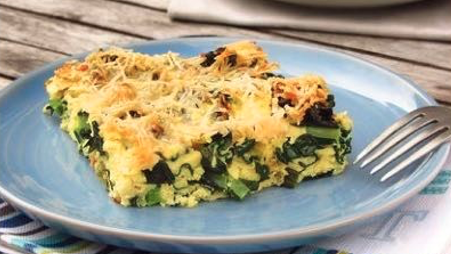
Kale Frittata
Author:
Annabelle Cooper
Category
Breakfast,Gluten Free,Low Carb,Lunch,Snack,Vegetarian
Difficulty
Beginner
Rated 5.0 stars by 1 users
6
15 mins
25 mins
40 mins
Ingredients
- 12 large eggs
- 3 cups dark leaf kale
- 3 medium spring onions
- 2 cups ricotta cheese
- 1 cup grated parmasan cheese
-
2 tbsp coconut oil or butter
-
½ tsp pink Himalayan salt or sea salt
-
ground black pepper
Directions
What are we cooking today?
Such a versatile dish as it works for breakfast, lunch or a mid afternoon snack. Healthy, easy to make and delicious hot or cold.
Getting started
- Preheat the oven to 175℃.
Wash and drain the kale leaves. You can use any dark-leaf kale. Note: Usually, the darker the leaves are, the less carbs they contain. You can steam the kale briefly or use fresh kale for more crispiness.
Remove the hard stems (if you haven't steamed the kale) and chop the kale into small pieces.
Clean and chop the spring onion. Place it in a non-stick pan greased with ghee or butter and cook until slightly browned.
Place the kale into a baking dish and add the browned spring onion. Mix to allow the oil and onion everywhere.
Crack the eggs into a bowl and add ricotta cheese. Season with salt and freshly ground black pepper and mix well.
Pour the egg mixture into the backing dish with the kale. Top with grated parmesan cheese and place in the oven for 25-30 minutes.
When done, remove from the oven and set aside for 15 minutes.
Enjoy either warm or cold!
Annabelle's tips
Try this kale frittata recipe with crispy bacon or fresh vegetables!
Nutrition
Nutrition
- Serving Size
- 6
- per serving
- Calories
- 360
- Total Fat
- 24 grams
- 31%
- Saturated Fat
- 13.1 grams
- 66%
- Cholesterol
- 408 milligrams
- 136%
- Sodium
- 583 milligrams
- 26%
- Total Carbohydrate
- 9.7 grams
- 4%
- Dietary Fiber
- 0.8 grams
- 3%
- Total Sugars
- 1.2 grams
- Protein
- 27.7 grams
- Calcium
- 35 milligrams
- 3%
- Iron
- 16 milligrams
- 89%
- Potassium
- 425 milligrams
- 10%
* The % Daily Value (DV) tells you how much a nutrient in a serving of food contributes to a daily diet. 2,000 calories a day is used for general nutrition advice.


